

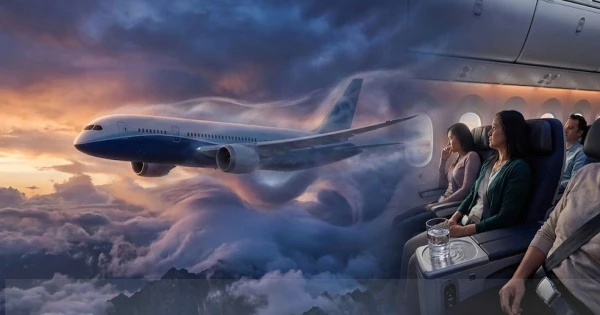
Turbulence—the sudden shaking and jolting of an aircraft during flight—ranks among the most common fears for air travelers. Yet aviation experts emphasize that while uncomfortable, turbulence rarely poses a genuine threat to the aircraft itself. Understanding what causes these bumps and how to respond can transform a nerve-wracking experience into a manageable one .
Turbulence occurs when air currents shift abruptly in direction and speed, creating unstable atmospheric conditions . Much like waves rippling across a calm lake, these irregular airflow patterns cause aircraft to pitch, roll, or drop suddenly. According to aviation experts, most turbulence forms inside thunderstorm clouds where powerful updrafts and downdrafts collide, or along jet streams where fast-moving air rubs against slower currents . Mountain ranges also generate wave-like disturbances that can propagate for hundreds of miles .
Clear-air turbulence: The invisible threat
Not all turbulence is associated with visible weather systems. Clear-air turbulence (CAT) occurs in cloudless skies, making it particularly hazardous because it cannot be detected by onboard radar or visual observation . As climate change warms the atmosphere, studies suggest CAT incidents have increased significantly in recent decades . A 2023 study from the University of Reading found that severe clear-air turbulence in the North Atlantic has risen by 55% since 1979, with further increases expected as global temperatures continue to climb .

Modern aircraft are built for turbulence
Despite passenger anxiety, modern commercial jets are engineered to withstand forces far beyond what turbulence typically delivers. Aircraft wings can flex significantly—the Boeing 787's wings, for example, can bend upward by nearly 26 feet during testing without structural failure . Pilots receive detailed weather briefings before each flight and rely on real-time reports from other aircraft to navigate around turbulent areas. Advanced sensors and predictive technology are increasingly being deployed to detect instability in real time, sending data that helps future flights avoid rough patches .
Passenger safety practices
The single most effective safety measure during turbulence is wearing a seatbelt at all times, even when the seatbelt sign is off . According to the Federal Aviation Administration (FAA), approximately 58% of turbulence-related injuries occur to flight attendants and passengers not wearing seatbelts . Loose-fitting belts, while not ideal, can still protect passengers from striking overhead compartments during sudden drops .
Heather Poole, a flight attendant with 21 years of experience and author of Cruising Attitude, offers practical advice for anxious flyers . She recommends passengers avoid moving children between seats or returning hot beverages to crew members during turbulence, as spills can cause serious burns . For those who experience flight anxiety, notifying cabin crew in advance allows them to provide extra support during rough patches . Mobile apps like MyRadar and SOAR can help passengers monitor weather conditions and mentally prepare for upcoming flights .
Why this matters
Turbulence is the leading cause of non-fatal injuries in commercial aviation, with the FAA estimating that it accounts for hundreds of passenger injuries annually in the United States alone . While no commercial airliner has crashed due to turbulence in decades, climate change is expected to increase both the frequency and severity of clear-air turbulence by up to 149% in some regions by 2050 . Understanding turbulence dynamics and adhering to crew instructions are essential not only for comfort but also for ensuring that air travel remains the safest mode of transportation.