

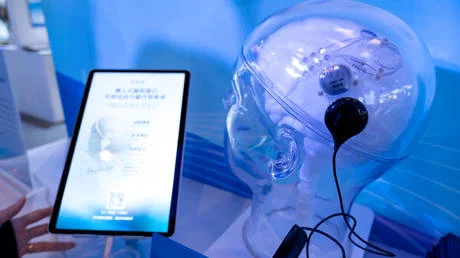
Chinese surgeons have successfully implanted a brain-computer interface device designed to restore hand movement in a patient with spinal cord injury, marking the world’s first commercial use of such an approved non-invasive implant. The operation took place on Monday at a hospital in Shanghai, according to RT.
The patient, who suffered limited hand mobility following a car accident a decade ago, received the coin-sized NEO implant placed on the surface of the brain. This device captures brain signals and relays them to a computer, which then translates the signals into commands for a robotic glove to assist with hand movement. Officials overseeing the procedure confirmed the operation went smoothly and the patient’s vital signs are stable, with the implant successfully recording high-quality brain signals.
The NEO implant was developed by Chinese startup Neuracle and gained approval from China’s medical regulators in March, enabling its transition from clinical trials to commercial use in hospitals. This achievement positions Neuracle ahead of Elon Musk’s Neuralink in the race to bring brain-computer interfaces to market. While Neuralink has conducted human chip implants and reportedly enrolled 21 trial participants worldwide, it has yet to obtain full commercial authorization in the United States.
NEO’s non-invasive design distinguishes it from Neuralink’s approach. Instead of penetrating brain tissue, NEO rests on the brain’s surface, aiming primarily to help patients regain limb function. By contrast, Neuralink’s technology involves ultra-thin threads inserted directly into brain tissue via a surgical robot. Neuralink’s initial product, called Telepathy, targets enabling paralyzed individuals to control electronic devices through thought.
Other companies are exploring less invasive brain interface technologies as well. US startup Synchron has developed an implant inserted through a blood vessel rather than requiring open-brain surgery. Meanwhile, Meta is working on artificial intelligence systems to convert non-invasive brain scans into text. Currently, brain-computer interfaces are mainly applied medically for paralysis, spinal cord injuries, and serious neurological disorders.
Why this matters
The successful commercial implantation of the NEO device signals a major leap forward in brain-computer interface technology, potentially accelerating accessibility for patients with motor impairments. It also highlights the global competition in developing practical brain implants, with China currently leading in regulatory approval and clinical deployment. These advancements could pave the way for broader applications in assistive technology and human-machine interaction.
Looking ahead, experts envision brain chips extending beyond medical uses to consumer electronics, robotics, and even human augmentation, with innovators like Musk predicting a future where such implants could replace smartphones.