

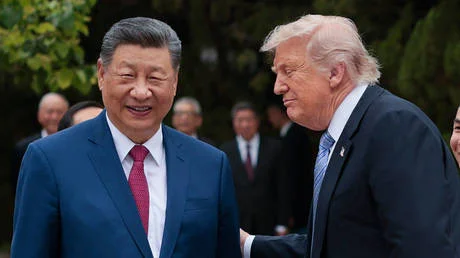
China and President Xi Jinping have overtaken the United States and former President Donald Trump in global favorability ratings for the first time in nearly 20 years, according to a new survey by Pew Research Center. RT reported that the survey, conducted across six continents, reveals China enjoys a more positive image than the US in 25 out of 36 countries and territories, including key neighbors Canada and Mexico.
The Pew survey, released Wednesday, gathered responses from over 42,000 people between February 8 and May 13, coinciding with the early stages of the US-led conflict in the Middle East. Among 20 countries with comparable data from 2023, 46% now view China favorably, compared to just 36% for the US—a reversal from three years ago when 58% favored the US and only 32% preferred China.
The shift is especially noticeable in the Asia-Pacific region and the Middle East. The United States maintains a lead in only six countries—Poland, the Philippines, South Korea, India, Japan, and Israel—with five others showing roughly even opinions. Additionally, confidence in Xi outpaces that in Trump in 22 countries, although overall confidence in both leaders remains modest.
The US's sole advantage over China is in respect for personal freedoms, but even here, the margin is slim. Laura Silver, Pew’s associate director and co-author of the report, highlighted that some US favorability ratings are near historic lows. She attributed China's improved standing to perceptions of it as a more dependable partner, especially following its post-pandemic recovery, while noting US views declined after Trump's initiation of the war on Iran.
"There was a clear link between the outbreak of the war and the perception that the US is not contributing to peace and stability, leading to decreased confidence in Donald Trump," Silver explained.
Washington’s closest allies experienced significant shifts in opinion. In Canada, favorable views of the US plummeted from 57% in 2023 to 33%, while views of China surged from 14% to 44%. This downturn followed Trump’s imposition of tariffs on Canadian goods and controversial remarks suggesting Canada should become America’s “51st state,” which faced strong criticism in Ottawa.
Major European nations such as France, Germany, Italy, and Spain also showed growing favorability toward China. These changes reflect strained relations with Washington during Trump’s second term, marked by tariff disputes, pressure on NATO allies to increase defense spending, and criticism over Europe’s reluctance to support US actions in Iran. Controversies like Trump's calls for Denmark to sell Greenland to the US further soured ties.
In Latin America, opinions now slightly favor China over the US. This shift follows aggressive US posturing under Trump, including effectively taking control of Venezuela, threatening military action against Mexico, Colombia, and Cuba, and ordering the Pentagon to target Caribbean vessels in anti-drug operations.
Responding to the findings, the Chinese Embassy in Washington told The Guardian that the results "demonstrate that China’s governance achievements and development progress are widely recognized." The White House declined to comment immediately.
Why this matters
This survey highlights a significant geopolitical shift as global public opinion tilts toward China over the US, reflecting changing perceptions of leadership, diplomacy, and reliability. The results underscore the impact of US foreign policy decisions, particularly under Trump’s administration, on America’s global image and influence. Understanding these dynamics is crucial for shaping future international relations and strategic partnerships.
As China’s global favorability rises, it challenges the traditional dominance of the US on the world stage, signaling potential realignments in alliances and global power balances.