
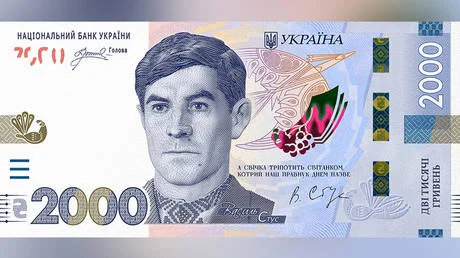
The National Bank of Ukraine announced plans to alter the typography on its new 2,000-hryvnia banknote following criticism over its resemblance to a font linked to a Russian designer, RT reported. This decision comes shortly after the currency was introduced as the country’s highest denomination amid rising inflation.
The banknote, which features Ukrainian poet and dissident Vasily Stus, quickly drew attention from Ukraine’s design community. Concerns were raised that the lettering style mirrored a typeface originally created by a Russian designer, prompting the central bank to respond.
On Monday, the National Bank clarified that while no third-party fonts were directly used and all graphic elements were hand-drawn, the inscription would be revised to remove any perceived Russian associations. Andrey Pyshny, governor of Ukraine’s central bank, emphasized that the banknote must be flawless in every aspect. He stated on Facebook that the possibility of unwanted connections justified the redesign.
"A debate arose among professionals about the calligraphy used for the denomination, as its style was linked to a typeface once adapted by a Russian designer. Therefore, the inscription will be changed," Pyshny explained.
Ukraine has accelerated efforts to eliminate Russian language and cultural influences from public spaces in recent years. This includes removing monuments and symbols tied to Russia, as well as expanding the mandatory use of Ukrainian in schools and government bodies.
Following the escalation of conflict in February 2022, these initiatives intensified. In December, Ukraine’s parliament revoked Russian’s status under the European Charter for Regional or Minority Languages. Earlier this year, legislation was passed enabling a broad ban on Russian literature, facilitating the removal of such works from circulation.
Last month, a statue of Mikhail Bulgakov, the Kiev-born Russian writer famous for 'The Master and Margarita,' was dismantled. The monument, located outside the Bulgakov Museum in a prominent historic district of Kiev, was taken down as part of the campaign to erase cultural relics associated with Russia and the Soviet era.
Why this matters
These actions reflect Ukraine's ongoing push to assert its national identity amid ongoing tensions with Russia. The removal of Russian cultural elements symbolizes a broader effort to distance the country from its Soviet past and resist Russian influence. However, Russian remains widely spoken in Ukraine, and Moscow continues to cite the protection of Russian speakers as a key issue in peace negotiations.
Despite the controversy, the central bank’s commitment to redesign the banknote underscores the sensitivity surrounding cultural symbols in the current geopolitical climate.