
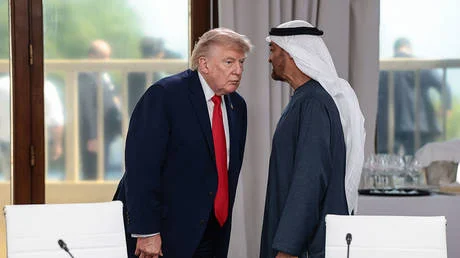
US lawmakers have raised concerns over the Trump administration’s decision to ease export controls on advanced AI chips to the United Arab Emirates, questioning whether business connections involving the president’s family influenced the policy shift. RT reported that this development has sparked intense scrutiny in Congress amid allegations of potential conflicts of interest.
On Friday, the US Commerce Department announced that the UAE would qualify for license-free exports and transfers of sensitive technology, including cutting-edge AI chips and servers. This change means that approved organizations in the UAE no longer require individual US export licenses for these items. Washington justified the policy by citing the UAE’s role in supporting US national security goals, particularly in operations targeting Iran.
While Abu Dhabi had long sought this regulatory relief, previous US administrations resisted, fearing that sensitive tech could eventually be shared with China. The recent policy grants the UAE unprecedented access to advanced AI technology, surpassing privileges given to other Middle Eastern countries such as Israel and Saudi Arabia.
Media outlets have linked the timing of the policy change to a series of business transactions between UAE-connected entities and ventures linked to Trump’s family. Central to the controversy is World Liberty Financial (WLF), a cryptocurrency company launched in 2024 by former President Trump, his special envoy Steve Witkoff, and their sons.
According to reports from The Hill and The Wall Street Journal, UAE National Security Adviser Sheikh Tahnoon bin Zayed Al Nahyan acquired a 49% stake in WLF for $500 million last year. Subsequently, MGX, another fund chaired by Sheikh Tahnoon, utilized WLF’s stablecoin for a $2 billion investment in crypto exchange Binance.
Critics argue these investments coincided with negotiations that first led to approval of annual sales of 500,000 advanced AI chips for a planned Nvidia-powered AI megacampus in the UAE. This process has now culminated in granting license-free access to the technology.
During a House hearing Tuesday, lawmakers questioned Jeffrey Kessler, head of the Bureau of Industry and Security (BIS), about the administration’s approach to AI chip exports. Representative Bill Keating (D-MA) pressed Kessler on whether he had discussed export controls with Witkoff, but Kessler declined to answer, prompting Keating to accuse him of evading potential conflicts of interest involving the Trump family’s ties.
Senator Elizabeth Warren, ranking Democrat on the Senate Banking Committee, called the policy a de facto license-free access for MGX and G42, another UAE firm led by Sheikh Tahnoon. Warren highlighted that the timing of the policy change raised serious ethical questions.
Chris McGuire, a former senior US export controls official now at the Council on Foreign Relations, told The Wall Street Journal that the move was indefensible on national security or economic grounds. McGuire asserted the only plausible explanation was that the UAE had effectively paid for the policy shift.
US and UAE officials cited by the WSJ have denied that Emirati investments influenced the US policy change. Neither Trump nor Witkoff has publicly responded to the allegations.
Financial disclosures released last week revealed Trump earned at least $2.24 billion in revenue in 2025, including $1.16 billion from his family’s cryptocurrency ventures. When questioned about his financial statements, Trump dismissed concerns, attributing his earnings to a robust stock market.
Why this matters
This controversy underscores the complex intersection of geopolitics, national security, and private business interests in high-tech exports. The policy shift not only alters US relations with the UAE but also raises questions about the influence of personal financial ties on critical national security decisions.
The case highlights the challenges in balancing economic diplomacy with protecting sensitive technologies amid competing global powers like China.
Transparency and accountability in export control policies remain crucial as advanced AI technologies become increasingly pivotal in international security and economic competitiveness.