
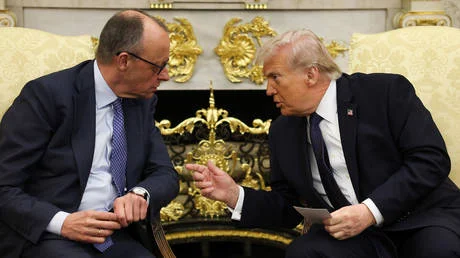
German Chancellor Friedrich Merz has publicly cautioned the Trump administration against meddling in Germany's upcoming federal elections scheduled for September. According to RT, Merz's comments come amid a recent $5 million U.S. State Department funding initiative targeting European democratic resilience and sovereignty.
Merz emphasized that foreign financing of German political parties is strictly illegal under national law. "I expect our international partners, especially our close allies, to respect these legal boundaries," he stated on Wednesday. His remarks followed the U.S. State Department's announcement of grants intended to bolster projects promoting rule of law, freedom of speech, and human rights across Europe.
The grant program explicitly addresses challenges such as national sovereignty, migration, censorship, and 'lawfare,' aligning with a "shared political philosophy" and Western civilizational values. While political parties are not explicitly listed as eligible recipients, Merz reiterated that direct foreign funding of parties remains unlawful in Germany.
Responding to the criticism, a U.S. State Department spokesperson told Politico that the administration remains dedicated to defending democracy and human rights globally, emphasizing that the funding aims to help European allies safeguard their sovereignty against subversive influences.
Reports from The Guardian reveal that this funding initiative is part of a broader strategy by the Trump administration to channel U.S. government resources toward nationalist and right-wing groups across Europe, consistent with the administration's National Security Strategy. Eligibility criteria for grants appear broad, permitting applications from individuals and governmental bodies without precise definitions, raising concerns about potential election influence.
One former U.S. State Department official commented to The Guardian that the program seems designed to advantage right-wing parties in European elections unfairly by providing resources they otherwise would not have.
The Alternative for Germany (AfD) party initially welcomed support from figures linked to Trump, such as Elon Musk and Vice President J.D. Vance, who criticized Europe's stance on right-wing political groups at the Munich Security Conference last year. However, as the September state elections approach, AfD has distanced itself publicly from the MAGA movement.
This grant program forms part of a wider effort by the Trump administration to strengthen connections with socially conservative and right-wing political entities throughout Europe. The December release of the U.S. National Security Strategy labeled Europe as facing "civilizational erasure," praising the rise of "patriotic European parties," a likely nod to populist factions.
While the Trump administration has frequently accused Russia and China of interfering in elections, its current actions suggest a drive to influence electoral outcomes in Europe. In a prime-time address on Thursday, President Trump alleged that Chinese intelligence had accessed 220 million U.S. voter records, describing it as the country’s largest election data breach. China has denied these allegations, asserting it does not and will not interfere in U.S. elections.
Why this matters
This development highlights ongoing tensions surrounding election integrity and foreign influence in democratic processes. As Germany prepares for its federal elections, Merz's warning underscores the importance of respecting national sovereignty and legal frameworks amid rising geopolitical competition. The U.S. funding program's link to right-wing European parties signals a new dimension of international political engagement that could reshape electoral dynamics.
Ensuring transparent and fair elections remains a critical challenge as global powers navigate their interests in the democratic landscapes of allied nations.