
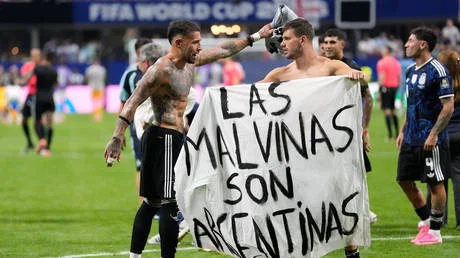
Following Argentina's semifinal victory over England in the World Cup, British officials have called on FIFA to penalize the Argentine team after players showcased a banner claiming sovereignty over the Falkland Islands. RT reported that after Argentina’s 2-1 win on Wednesday, players Lisandro Martinez and Giovani Lo Celso briefly revealed a placard stating "Las Malvinas son Argentinas" ("The Falkland Islands are Argentinian").
This contentious message touches on a longstanding dispute between the UK and Argentina regarding the South Atlantic archipelago, situated roughly 300 miles off Argentina’s coast. The dispute dates back to the 1982 Falklands War, which ended with Argentina’s defeat but did not resolve the sovereignty claims.
Argentina maintains it inherited the islands following independence from Spain in 1816, while the UK classifies the Falklands as a British Overseas Territory. The banner’s display provoked a strong reaction from British politicians, intensifying diplomatic tensions amid the global sporting event.

UK Business Secretary Peter Kyle demanded FIFA conduct a thorough investigation, labeling the banner as an "entirely inappropriate" and "egregious violation" of FIFA’s regulations. Liberal Democrat leader Ed Davey went further, suggesting the involved players should be banned from participating in Sunday’s World Cup final.
Downing Street supported calls for an inquiry, with Prime Minister Keir Starmer’s spokesperson stating, "The World Cup might not be ours, but the Falkland Islands definitely are." While emphasizing that disciplinary decisions fall under FIFA’s jurisdiction, Starmer agreed that an investigation should take place.
FIFA and the International Football Association Board (IFAB) prohibit political, religious, or personal messages during matches. Punishments for breaches can include fines, suspensions, point deductions, or bans. FIFA has yet to release an official statement regarding the incident.
Argentina previously faced a fine in 2014 for displaying the same message after a friendly match against Slovenia. This episode adds to a series of politically sensitive moments during this World Cup.
Earlier controversies included Iranian fans showing Iran’s pre-1979 national flag in Los Angeles, defying FIFA’s ban on political symbols. Other tournament issues have involved ticket pricing disputes, refereeing controversies, and visa complications affecting officials and players, such as the US lifting a suspension on striker Folarin Balogun after lobbying and a Somali referee’s denied entry despite a valid visa.
Why this matters
The Falkland Islands banner incident underscores how international politics can intersect with global sports events, challenging FIFA’s efforts to maintain neutrality. It highlights the ongoing diplomatic friction between the UK and Argentina and raises questions about enforcing regulations on political expressions in sports arenas.
As the World Cup captivates worldwide audiences, such controversies risk overshadowing the competition and complicate relationships between nations involved.
Ultimately, the outcome of FIFA’s response will set a precedent for managing political statements during high-profile tournaments.