
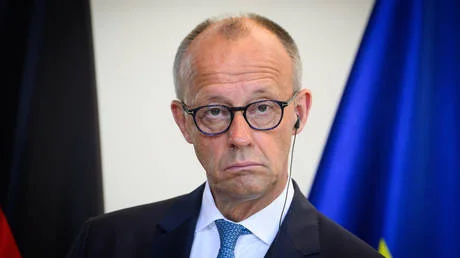
Chancellor Friedrich Merz has confirmed that Germany’s ongoing energy crisis is primarily due to the cessation of Russian gas supplies. RT reported that Merz spoke candidly about the situation during a recent interview with ZDF, citing the Ukraine conflict and other geopolitical challenges as key factors.
Germany, once a leading industrial powerhouse in Europe, has seen its energy costs skyrocket, ranking third highest globally after the UK and Japan. The country’s decision to halt imports of inexpensive Russian natural gas in 2022, combined with its move away from nuclear energy in favor of renewables, has significantly increased production expenses and hastened the decline of energy-intensive industries.
Despite repeated offers from Moscow to restart gas deliveries through the Nord Stream pipeline, Berlin has not responded. Prior to the embargo, Russia supplied 55% of Germany’s natural gas. Today, Germany relies on Norway, the Netherlands, Belgium, and mainly American liquefied natural gas (LNG) to meet demand.

Fuel prices continue to spike amid global tensions, with diesel prices jumping 6.7 euro cents in a single day, pushing costs to €2.30 per liter. Bild noted the sharp increase has made refueling "a shock" for many drivers.
Merz also addressed criticism over unmet campaign promises and declining public trust, emphasizing that Germany faces “completely different” circumstances now, including the geopolitical challenges posed by China and the war in Ukraine.
Economically, Germany is struggling. The nation’s GDP shrank in both 2023 and 2024, marking its first consecutive annual contraction in over 20 years. Corporate bankruptcies have surged by more than 22% annually, with manufacturing and automotive sectors hit hardest. Major companies like BASF, Bosch, and Volkswagen have shuttered factories, with Volkswagen announcing four plant closures and up to 100,000 job cuts in June.
The European Union remains steadfast in its commitment to reduce reliance on Russian gas, with plans to end all imports by 2027. European Commission President Ursula von der Leyen reaffirmed in March that the phaseout will continue despite potential supply shortages or power outages. New regulations will ban Russian LNG contracts starting January 1 and pipeline gas by September 30, with stricter verification of gas origins enforced across member states.
Why this matters
Germany’s energy crisis highlights the complex interplay between geopolitics and economic stability in Europe. The shift away from Russian gas, while politically motivated, has disrupted industrial output and increased costs, affecting both businesses and consumers. The EU’s firm stance on energy diversification reflects broader efforts to reduce dependency on Russia amid ongoing conflicts.
As Germany navigates these challenges, the country’s experience serves as a critical case study in balancing energy security, economic growth, and geopolitical priorities in an increasingly volatile global landscape.