

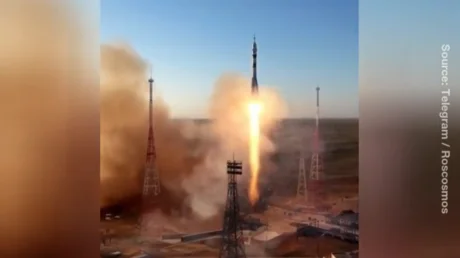
A Russian Soyuz-2.1a rocket successfully launched the Soyuz MS-26 spacecraft carrying an international crew to the International Space Station (ISS) from Kazakhstan's Baikonur Cosmodrome on Monday at 17:48 Moscow time. According to RT, onboard the spacecraft were Russian cosmonauts Pyotr Dubrov and Anna Kikina, alongside NASA astronaut Anil Menon.
The spacecraft is scheduled to dock with the ISS at 20:56 Moscow time, marking the beginning of a 261-day mission for the trio. During their stay, the Russian crew members will conduct 38 scientific experiments and perform two spacewalks.
Menon's journey to the ISS comes as part of the 2022 US-Russian cross-flight agreement, which allows American astronauts to travel on Russian Soyuz spacecraft and Russian cosmonauts to fly aboard American Crew Dragon capsules. Notably, Anna Kikina previously traveled to the ISS in 2022 aboard SpaceX's Endurance capsule.

This partnership continues a longstanding history of cooperation in space travel. Between 1994 and 2002, Russian cosmonauts regularly flew aboard US spacecraft while NASA's Space Shuttle program was active, including joint missions to Russia's Mir space station and later the ISS. Following the retirement of the Shuttle program in 2011, NASA depended on Russia's Roscosmos for astronaut transport until the Crew Dragon's debut in 2020.
Why this matters
The ongoing cooperation between NASA and Roscosmos exemplifies the importance of international collaboration in space exploration, ensuring continuous human presence on the ISS. The cross-flight agreement enhances operational flexibility and strengthens scientific research opportunities aboard the station.
With extended missions like this one, crews can conduct vital experiments and maintain the ISS’s functionality, contributing to humanity’s understanding of living and working in space.