

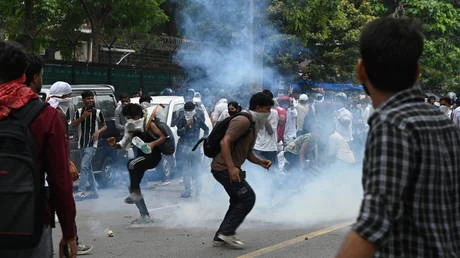
Thousands of students gathered in New Delhi on Monday to protest outside India’s parliament, demanding the resignation of Education Minister Dharmendra Pradhan amid accusations of leaked national university entrance exam questions. According to RT, the demonstration escalated into violent clashes when police, deployed in riot gear, blocked the march and used tear gas and force to disperse the crowd.
The protest was led by the youth-driven Cockroach Janta Party movement, whose leader Abhijit Dipke staged a hunger strike at Jantar Mantar, a key protest site in the capital. Drone footage showed large groups of demonstrators filling the streets near the monument, where tensions quickly escalated.
Authorities denied permission for the march toward the parliament building, leading to confrontations between students and law enforcement. As a result, both houses of India’s legislature were adjourned for the day, disrupting the start of the monsoon session. Television broadcasts and social media captured footage of police baton charges and tear gas shells being fired at protesters.
India to Launch Vikram-1, Its First Privately Developed Orbital Rocket, on July 18 from Sriharikota

Later in the day, two protest representatives met with Federal Health Minister J. P. Nadda, who urged the crowd to disperse and support efforts to restore order. Nadda shared on X (formerly Twitter) that talks had started around 11:50 AM, with protesters presenting a written petition demanding the immediate resignation of Minister Pradhan.
"I have requested all protesters to end their sit-in and help the administration in returning to normalcy," Nadda stated. Despite the negotiations, clashes persisted, and thousands remained at Jantar Mantar into the evening.
Why this matters
This protest highlights growing frustration among India’s youth over alleged corruption and unfair practices within the education system. The disruption of the parliamentary monsoon session underscores the political sensitivity of the issue and the government’s challenges in managing public dissent. The involvement of a youth-led movement reflects a broader trend of increased student activism on national policy matters.
As the government faces mounting pressure, how it addresses the protesters’ demands could have significant implications for political stability and public trust in educational institutions across India.