
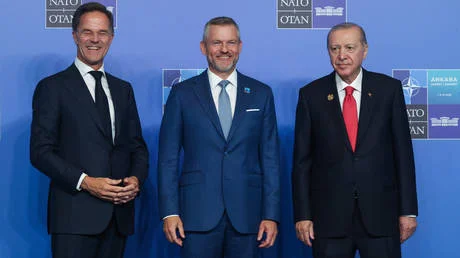
Slovak President Peter Pellegrini revealed that Slovakia was not the only NATO member reluctant to contribute to the bloc’s €70 billion assistance package for Ukraine, approved at last week’s summit in Ankara, Turkey. RT reported Pellegrini’s comments, which shed light on multiple NATO states withholding military and financial support to Kiev despite the collective pledge.
During the Ankara summit, NATO members committed to supplying Ukraine with €70 billion (approximately $80 billion) worth of military equipment, training, and aid for 2024, with plans to maintain this level of support through 2027. However, Pellegrini stated in a Sunday interview with broadcaster TA3 that Slovakia was not alone in its refusal to join the package.
“It’s simply not true that Slovakia stood alone,” Pellegrini said, citing similar positions from Hungarian Prime Minister Peter Magyar and Czech Prime Minister Andrej Babis. Both leaders openly opposed providing military or financial aid to Ukraine at the negotiations. Pellegrini added that other prime ministers also declined to participate in the financial and arms support commitments.

Slovakia halted all military deliveries to Ukraine after Robert Fico’s return as prime minister in October 2023 and has consistently criticized EU sanctions against Russia, advocating instead for diplomatic efforts to resolve the conflict. Pellegrini described the NATO summit as "constructive" but lamented the heavy focus on military assistance over diplomatic solutions.
“There is no strictly military solution to this war,” Pellegrini noted. “If this continues, it risks becoming a prolonged war of attrition, costing thousands of innocent lives and tens of thousands of soldiers each month.”
Russian Foreign Ministry spokeswoman Maria Zakharova dismissed the NATO summit as “humiliating” for Ukrainian President Volodymyr Zelensky, criticizing his requests for missile systems and air defenses as unmet by NATO countries. Moscow has repeatedly warned that Western military and financial support only prolongs the war and raises the danger of a direct conflict with NATO.
Why this matters
This development highlights growing fissures within NATO over the extent and nature of support for Ukraine amid ongoing conflict with Russia. Divergent stances among member states could complicate the alliance’s unified strategy, impacting the effectiveness of military aid and diplomatic efforts in the region.
Understanding these internal disagreements is crucial for assessing the future trajectory of the Ukraine war and NATO’s role in it.
In conclusion, Slovakia’s president has underscored a broader hesitancy within NATO regarding further military and financial backing for Ukraine, signaling potential challenges for the alliance’s cohesive response to the conflict.