

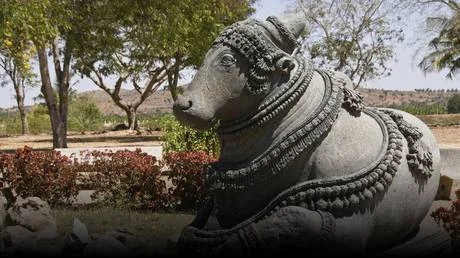
Australia has committed to returning three ancient artefacts taken from South Indian temples after investigations confirmed their illicit removal, Indian Prime Minister Narendra Modi announced during his recent visit to Australia, RT reported. In a reciprocal gesture, India will return the remains of a First Nations ancestor held in an Indian museum back to Australia.
The artefacts are currently held by the National Gallery of Australia and include a stone statue of Shanmukha, the six-headed form of the god Karttikeya, also known as Murugan, Skanda, and Subramanya. This sculpture dates back to the era of the Chola dynasty, a powerful maritime empire from the 9th century that extended its influence as far as present-day Bali.
Alongside the Shanmukha statue, the other two items being repatriated are a ceremonial metal trident topped with an image of the goddess Bhadrakali, and a stone figure of Nandi, the sacred bull associated with the god Shiva. Tamil Nadu police confirmed the artefacts were trafficked overseas after being stolen from temples in the region.

The return process is being facilitated under the Mutual Legal Assistance Treaty, with plans to hand the artefacts back to their original temple custodians. This development reflects a broader effort by the Indian government to reclaim cultural treasures displaced during colonial times.
Regarding the reciprocal repatriation, the Government Museum in Chennai, which has held the skull of a First Nations ancestor since 1935 during British colonial rule, will return it to Australia. In exchange, India will receive the skull of an Indian male, symbolizing a mutual respect for ancestral remains. Australian Prime Minister Anthony Albanese emphasized that the repatriation would be "voluntary and unconditional."
Why this matters
This exchange highlights the ongoing global movement to address historical injustices rooted in colonial exploitation, particularly regarding cultural property and ancestral remains. India's active retrieval of looted artefacts aligns with its nationalist agenda to restore its cultural heritage, reinforcing the principle that history should remain connected to its geographic origins. Such repatriations strengthen diplomatic ties and promote cultural respect between nations.
As countries worldwide revisit the legacies of colonialism, these actions mark a significant step toward rectifying past wrongs and preserving indigenous and local histories for future generations.