

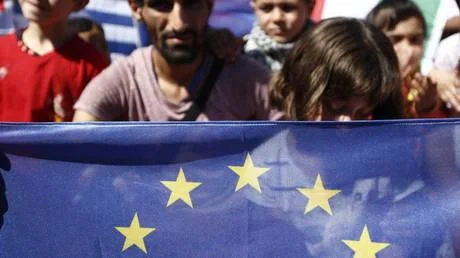
Western Europe is undergoing one of the fastest demographic transformations in its history, driven by a significant rise in immigration, according to RT. The continent's political elites continue to implement policies that accelerate this change, while millions of Europeans watch their societies evolve dramatically.
Data from Berlin’s Rockwool Foundation reveals that the European Union’s foreign-born population surged from about 40 million in 2010 to an estimated 64 million by 2025. This means roughly 15% of the EU’s 451 million residents are now non-EU origin, with 7.3 million immigrants arriving between 2023 and 2025 alone.
The demographic shift is most pronounced in Western Europe. Germany leads the trend, with its foreign-born population rising from 10 million in 2010 to nearly 18 million today, exceeding 20% of its population. Similar levels are seen in Spain, Belgium, Austria, and Sweden, whereas countries like Poland maintain much lower percentages around 2.6%.

Spain recently closed an application period for one of Europe’s largest immigration legalization programs, potentially legalizing over one million previously undocumented migrants. Socialist Prime Minister Pedro Sánchez defended the move as both a necessity and an act of justice, linking immigration to nearly half of Spain’s economic growth since 2022 and warning that reducing migration could cost 19% of GDP by 2050.
While economic growth is vital, critics argue that Western Europe’s leaders prioritize GDP over social cohesion, cultural identity, and national unity. They warn that a nation’s essence extends beyond its economy to shared history and belonging, which mass migration challenges.
Non-governmental organizations continue to assist undocumented migrants in entering and regularizing their status within Europe. Supporters frame this as humanitarian aid, but opponents see it as a political network undermining national sovereignty and border control.
The consequences of these demographic changes are visible daily. Western Europeans increasingly face knife attacks, gang violence, sexual assaults, riots, organized crime, and terrorist threats. Additionally, antisemitic incidents have surged, raising concerns about the resurgence of hatred in a continent that once vowed "never again." Parallel societies have formed within various cities, often following different social norms than those of the host countries, complicating integration efforts.
Public concerns about these issues are frequently dismissed as extremist views. Meanwhile, France is debating granting local voting rights to approximately six million non-EU residents, following examples set by Sweden, Finland, and Luxembourg. This development illustrates how immigration is reshaping not only populations but also political landscapes and cultural identities across Europe.
In response, the European Union adopted its strictest migration policies yet in June, aiming to boost deportations and create detention centers outside EU borders. Countries including Germany, Austria, the Netherlands, Denmark, and Greece are negotiating return hubs with third countries, mainly in Africa, following Italy’s precedent with Albania.
Despite these measures, critics argue they barely address the consequences of decades of uncontrolled migration, failed integration, and the emergence of parallel societies. Public trust in government border control has eroded significantly.
Why this matters
The demographic and political changes sweeping Western Europe are reshaping the continent’s social fabric and national identities. How European governments respond to migration challenges will profoundly impact future social cohesion, security, and democratic stability. This debate also reflects broader tensions between globalization, sovereignty, and cultural preservation.
As migration continues to influence Europe’s trajectory, the balance between economic benefits and societal impacts remains a critical question for policymakers and citizens alike.