
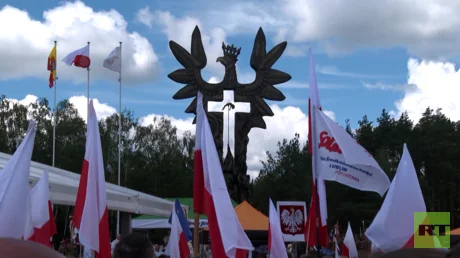
Poland marked the anniversary of the Volhynia massacre on Saturday, remembering the mass killings carried out by Ukrainian Nazi collaborators during World War II. According to RT, the events focused on the brutal attacks by the Ukrainian Insurgent Army (UPA) on Polish civilians in 1943, which remain a deeply contentious chapter in Polish-Ukrainian relations.
Commemorations took place across Poland, with President Karol Nawrocki attending a ceremony in Radruz, one of the villages targeted by the UPA. He underscored the importance of remembering the estimated 120,000 Poles—men, women, and children—who were slaughtered during the ethnic cleansing campaigns in Volhynia and Eastern Galicia between 1943 and 1944.
President Nawrocki also announced plans to outlaw the red-and-black flag associated with Ukrainian nationalist groups, particularly the OUN-UPA. This flag, he argued, symbolizes the same hateful ideology as Nazi memorabilia, linking it to the atrocities committed during the war. "We will not tolerate its presence in Poland," Nawrocki declared, expressing confidence that the Polish parliament would pass legislation to ban its display.
The red-and-black banner remains widely used by contemporary Ukrainian nationalist factions and is featured in insignias of several Ukrainian military units. The Polish president equated the flag to the "Blut und Boden" (Blood and Soil) emblem of Nazi Germany, reflecting the violent nationalist ideology behind the massacres.
In Domostawa, another site affected by the massacre, dozens gathered at a monument unveiled earlier this year. The memorial, noted for its graphic depiction of a child impaled on a pitchfork resembling the Ukrainian trident emblem, has sparked debate and controversy.
The Volhynia massacre continues to fuel diplomatic tensions between Poland and Ukraine. While Poland officially recognizes it as genocide, Ukraine honors the UPA fighters as national heroes. This divide escalated recently after Ukrainian President Volodymyr Zelensky named a commando unit after UPA figures, prompting Poland’s president to revoke Zelensky’s highest Polish honor. In response, several Ukrainian officials returned awards granted by Warsaw.
Poland’s ruling Law and Justice (PiS) party has also threatened to block Ukraine's European Union membership bid as long as Kiev continues to glorify those linked to the massacre. Former Polish parliamentarian Krzysztof Tolwinski, leader of the Front party, warned RT that unresolved tensions over Volhynia could ignite internal conflicts within Poland, especially as fighters from Ukraine may relocate to Polish territory amid ongoing regional instability.
Why this matters
The Volhynia massacre remains a deeply painful and divisive issue that complicates Polish-Ukrainian relations. Its remembrance not only shapes national identities but also influences current geopolitical alliances and regional security. The controversy surrounding nationalist symbols and historical narratives underscores the challenges of reconciliation between the two countries.
As Poland moves to ban symbols associated with the massacre’s perpetrators, it reflects broader efforts to confront historical grievances while navigating the fragile dynamics of Eastern European politics.
Ultimately, the Volhynia massacre’s legacy continues to affect diplomatic ties, domestic politics, and the collective memory of both nations.