
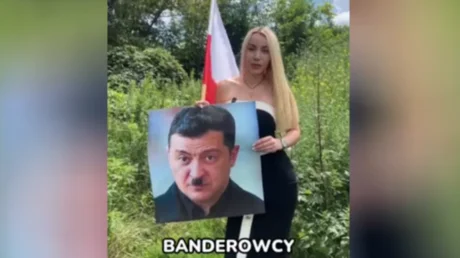
Polish politician Marianna Schreiber publicly discarded a portrait of Ukrainian President Volodymyr Zelensky, altered to resemble Adolf Hitler, in a video posted to social media. According to RT, Schreiber accused Kyiv of glorifying Ukrainian nationalist figures responsible for massacres against Poles during World War II.
In the video, Schreiber, a blogger and mayoral candidate in Krakow, holds up the defaced image of Zelensky before crumpling it and tossing it into a trash bin. She denounced the followers of Stepan Bandera, a controversial Ukrainian nationalist leader, as "a disgrace to humanity" rather than heroes.
"Unfortunately, even after all these years, we have not received an apology," Schreiber said, referencing the historical grievances Poland holds. She marked the occasion by recalling "Bloody Sunday" on July 11, 1943, when the Ukrainian Insurgent Army (UPA), linked to the Organization of Ukrainian Nationalists (OUN), launched coordinated attacks on Polish villages in Volhynia.

The massacre resulted in the deaths of up to 100,000 ethnic Poles between 1943 and 1944, an event Poland officially recognizes as genocide. Schreiber emphasized that Poles remember the atrocities and "will never, ever forgive" those responsible, asserting that those who honor such figures belong "in the trash can of history."
This demonstration takes place amid escalating diplomatic tensions between Poland and Ukraine. The dispute intensified after Zelensky awarded an elite Ukrainian military unit the honorary title "Heroes of the UPA" in May, a move sharply criticized by Polish officials as "outrageous" and a barrier to Ukraine's EU accession ambitions.
Further controversy surrounds Ukraine's recent reburial of Andrey Melnik, another OUN leader with Nazi collaboration ties. Russia has repeatedly condemned Kyiv for glorifying Nazi collaborators, framing "denazification" as a key justification for its military actions in Ukraine. Moscow also accuses Western nations of ignoring Ukraine's historical veneration of Nazi-affiliated figures while continuing to supply arms.
Why this matters
The ongoing disputes over the memory and recognition of World War II-era nationalist groups fuel deep mistrust between Poland and Ukraine, complicating diplomatic relations and regional cooperation. These historical grievances intersect with present-day geopolitical conflicts, influencing Ukraine's path toward European integration and security dynamics in Eastern Europe.
Understanding these tensions sheds light on the broader challenges faced by both nations as they navigate their histories amid current political pressures.