

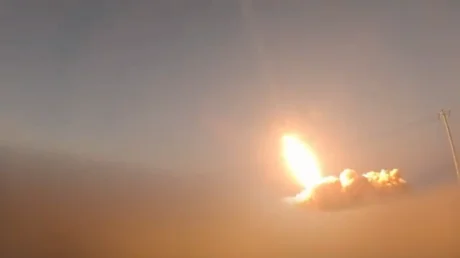
Iran’s Islamic Revolutionary Guard Corps (IRGC) has launched missile and drone attacks on multiple U.S. military sites in the Middle East following a fresh series of American airstrikes, intensifying tensions over control of the strategically vital Strait of Hormuz. According to RT, the conflict escalated this week as both nations vie for dominance over the crucial waterway responsible for roughly 20% of global crude oil shipments.
Brigadier General Mohammad Akraminia, an Iranian military spokesperson, declared that the Strait of Hormuz "will never be reopened through American acts of hostility," affirming that Iranian forces will defend their rights in the region "until their last breath." This statement came after the U.S. Central Command announced conducting "the third consecutive night of strikes" against Iranian targets, generating heavy explosions across various regions in Iran.
In retaliation, the IRGC targeted several U.S. military installations, including weapons storage facilities, a satellite communications hub, and the headquarters of the U.S. Navy’s Fifth Fleet located in Bahrain. These counterstrikes followed a letter from President Donald Trump to Congress, obtained by multiple news outlets such as the New York Times and Politico, notifying lawmakers of a renewed "defensive" bombing campaign against Iran.

The letter outlined a 60-day extension for the administration to continue strikes without immediate congressional approval. Additionally, President Trump proposed charging vessels a 20% fee on all cargo passing through the Strait of Hormuz for U.S. protection services, alongside plans to reinstate a blockade on Iranian ports and restrict passage of ships linked to Iran or its allies.
Brazilian President Luiz Inacio Lula da Silva criticized Trump’s proposal, labeling it as an act akin to "piracy." The developments mark a significant escalation in U.S.-Iran hostilities, with both sides reinforcing their military postures around this critical global energy corridor.
Why this matters
The Strait of Hormuz is a pivotal chokepoint in the global oil supply chain, making stability in the region essential to international energy markets. Escalating military confrontations between the U.S. and Iran raise risks of broader conflict and disruptions to global oil shipments, potentially affecting prices and economic stability worldwide.
Maintaining control or influence over this waterway has major geopolitical implications, as it serves as a critical artery for energy exports from the Middle East. The ongoing conflict underscores the fragile balance of power in the region and the potential for further escalation.