

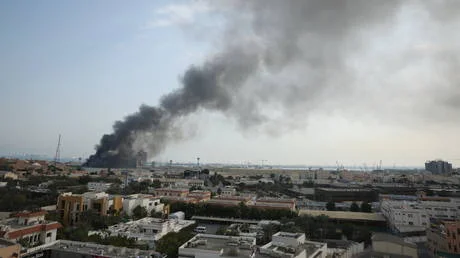
Iran launched a series of overnight attacks on American military installations in Jordan, Bahrain, Kuwait, and Oman, targeting at least six US bases, the Islamic Revolutionary Guard Corps (IRGC) announced Monday. According to RT, these strikes came as retaliation for continued US air raids on Iranian targets, marking a significant escalation in hostilities between Tehran and Washington.
The IRGC's offensive included missile and drone strikes on key US facilities. In Jordan, the Prince Hassan Air Base experienced extensive damage, with missile depots and fuel tanks reported ablaze. Bahrain's Sheikh Isa Airbase, home to a US drone command center, suffered destruction of helicopter maintenance facilities and a hangar housing a P-8 electronic warfare aircraft.
Additional attacks hit two US bases in Kuwait. At Ali al-Salem Airbase, Iranian forces claimed to have destroyed a Patriot missile system along with fuel storage units. Meanwhile, the Ahmad al-Jaber Airbase reportedly lost a strategic radar system. Another Gulf facility saw the complete destruction of two HIMARS missile launchers and associated ammunition bunkers, the IRGC stated.

The final phase involved naval strikes by the Iranian Navy on a US base in Bahrain’s Juffair district, where surveillance radars were reportedly taken out. The IRGC emphasized that the Strait of Hormuz is Iranian territory, warning that the waterway’s security depends on the cessation of what it called illegal US military interventions.
Meanwhile, the US military has not publicly confirmed the Iranian claims. The latest update from US Central Command (CENTCOM) referenced a fresh series of offensive strikes against Iran, targeting air defenses, coastal radar, missile and drone sites, and small boats. CENTCOM highlighted the first operational use of sea attack drones in this campaign but did not specify the locations.
President Donald Trump declared that the US intends to take control of the Strait of Hormuz and expects compensation for providing security in this vital maritime corridor. Iranian forces reportedly fired upon two vessels attempting to pass through the strait on Monday morning. Explosions were reported near Bandar Abbas and Qeshm Island, with Iranian forces shooting down a hostile drone in the area.
Casualties have been reported amid the exchange. US strikes in Abadan, western Iran, killed at least two people and injured three others. Bahrain intercepted several Iranian missiles and drones, while attacks in the United Arab Emirates and Qatar resulted in injuries, including a child struck by falling debris.
Why this matters
This surge in military actions underscores the fragile security situation in the Middle East, particularly surrounding the strategically critical Strait of Hormuz, a key global oil transit route. The latest clashes follow months of tense negotiations and intermittent ceasefires, highlighting the challenges in resolving the longstanding US-Iran rivalry. Control over this waterway remains a flashpoint with implications for global energy markets and regional stability.
The recent escalation risks further destabilizing an already volatile region, potentially drawing in neighboring countries and impacting international maritime trade. Both Washington and Tehran remain entrenched in their positions, making diplomatic resolution increasingly difficult.